Understanding Auditory Processing Disorder in Parksville's Active Community

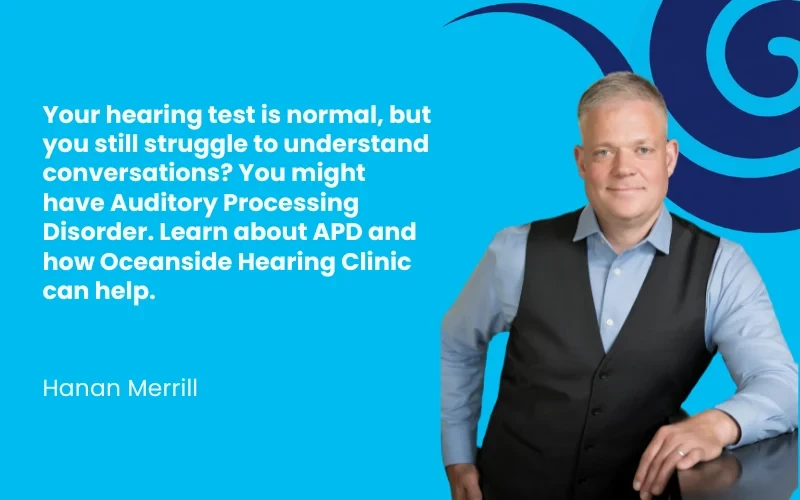
You've had a hearing test and been told everything is normal. Yet you still struggle to understand conversations in restaurants, miss parts of what people say, and feel exhausted after social gatherings. You're not imagining it - you might have Auditory Processing Disorder.
At Oceanside Hearing Clinic, we see this scenario regularly. Someone comes in frustrated because they know something isn't right with their hearing, but they've been dismissed or told there's nothing wrong. Sometimes they've even been fitted with hearing aids that don't seem to help. The problem isn't always about how well you hear sounds - sometimes it's about how your brain processes those sounds.
That's where Auditory Processing Disorder (APD) comes in.
What Is Auditory Processing Disorder?
Auditory Processing Disorder is a condition where your ears work perfectly fine, but your brain has difficulty interpreting the sounds it receives. Think of it like this: your ears are the microphone picking up sound, but somewhere between that microphone and your brain's understanding center, the signal gets garbled.
People with APD can hear that someone is talking. They know words are being said. But their brain struggles to quickly and accurately decode what those words mean, especially in challenging listening situations. It's not about volume - turning things up louder doesn't solve the problem. It's about clarity of processing.
As one of our patients described it, "It's like trying to have a conversation on a cell phone with a bad connection. I can hear that you're talking, but I can't quite make out what you're saying."
APD affects approximately 2-7% of the population, though many cases go undiagnosed because the symptoms are often attributed to other causes or simply dismissed as "not paying attention."
Signs You Might Have APD
Auditory Processing Disorder can affect people differently, but there are common patterns we see. If several of these sound familiar, it's worth investigating further.
In social situations, you find yourself frequently asking "What?" or "Can you repeat that?" even though you don't have trouble hearing other sounds. You struggle to follow conversations in restaurants, at community events, or anywhere with background noise. The Farmers Market, a busy coffee shop, or a gathering at the Oceanside Place arena - these environments become exhausting because your brain is working overtime to decode speech.
At home, family members might complain that you don't listen or seem distracted when they're talking to you. You might turn the TV volume up high but still struggle to follow dialogue, especially in shows with multiple characters talking or background music. Following multi-step directions can be challenging - you might hear them but have trouble retaining and processing all the information.
In your daily life, you may find that you're a very visual learner and prefer written instructions to verbal ones. You might have difficulty remembering people's names after meeting them, struggle with directions given verbally, or find yourself mishearing similar-sounding words. Background noises that others seem to tune out - the hum of an air conditioner, traffic sounds, other conversations - are incredibly distracting to you.
Emotionally and mentally, you feel drained after social interactions because of the concentration required. You might avoid certain situations where you know communication will be difficult. Some people with APD describe feeling embarrassed or frustrated, worried that others think they're not intelligent or not paying attention.
Why APD Often Goes Undetected
Here's the frustrating part: standard hearing tests don't detect APD.
When you have a hearing test (called an audiogram), it measures your ability to hear different pitches at different volumes. It tells us whether sounds are reaching your brain. For most people with APD, this test comes back completely normal. Your ears are working fine.
But an audiogram doesn't measure what your brain does with those sounds once they arrive. It doesn't assess how quickly you process speech, how well you separate speech from background noise, or how accurately you interpret what you hear. Those are central auditory processing skills, and they require different, more specialized testing.
This is why so many people with APD spend years knowing something is wrong but being told their hearing is fine. It's also why some people get fitted with hearing aids based on a standard hearing test, but the aids don't help - because the problem was never about volume or frequency. It was about processing.
APD in Parksville's Active Adult Community
Parksville and the Oceanside region have a vibrant, active population. Whether you're retired and enjoying an active social life, working in local businesses, or raising a family here, APD can significantly impact your quality of life.
Think about the community activities that make this area special. Coffee meetings with friends at local cafés. Community events and concerts. Volunteer work. Golf outings where conversation is part of the game. Beach walks where wind and waves create background noise. Family gatherings with multiple conversations happening simultaneously.
All of these situations require your brain to process auditory information quickly and accurately, often while filtering out competing sounds. For someone with APD, these scenarios go from enjoyable to exhausting.
We've worked with active adults who avoided social gatherings because they were too draining. Professionals who struggled in meetings and worried about their job performance. Family members who felt isolated because communication at home had become so difficult. The impact of undiagnosed APD extends far beyond just "not hearing well."
How We Diagnose APD
At Oceanside Hearing Clinic, we offer comprehensive auditory processing evaluations that go well beyond standard hearing tests.
Our assessment looks at multiple aspects of how your brain processes sound. We evaluate your ability to understand speech in background noise, process rapid or degraded speech signals, detect small timing differences in sounds, separate competing messages coming into each ear, and recognize patterns in sounds.
These tests are non-invasive and painless, but they are more complex than a basic hearing test. We create various challenging listening situations to see how your auditory system responds. The results give us a detailed picture of where your processing strengths and weaknesses lie.
Importantly, we also rule out other potential causes of your symptoms. Sometimes what appears to be APD is actually related to attention issues, language processing disorders, cognitive factors, or even undetected hearing loss in specific frequencies. A thorough evaluation ensures we identify the real issue.
Treatment Options That Actually Help
Here's the good news: while there's no "cure" for APD, there are effective strategies and treatments that can make a significant difference.
Environmental modifications can help tremendously. We work with you to identify the situations where you struggle most and develop practical strategies. This might include positioning yourself with your back to walls in restaurants to reduce background noise, requesting written confirmation of verbal instructions, using visual cues and note-taking, or choosing quieter venues for important conversations.
Assistive listening technology can be incredibly helpful for people with APD. This might include FM systems or remote microphone systems that transmit speech directly to your ears while reducing background noise. Even certain types of hearing aids or personal amplifiers can help, not by making things louder, but by enhancing speech signals and reducing competing noise.
Auditory training involves specific exercises designed to strengthen your brain's ability to process sounds. Think of it like physical therapy for your auditory system. These targeted activities can help improve your discrimination of similar sounds, your processing speed, your memory for auditory information, and your ability to understand speech in noise.
Compensatory strategies teach you practical ways to manage your APD in daily life. This includes skills like advocating for yourself by asking speakers to face you, requesting clarification without embarrassment, breaking down complex verbal information into smaller chunks, and verifying important information by repeating it back.
Communication partner training involves teaching the people you interact with most - family members, close friends, colleagues - how to communicate with you more effectively. Simple changes like getting your attention before speaking, speaking at a moderate pace with clear articulation, and reducing background noise can make a huge difference.
Why Specialized Care Matters
Auditory Processing Disorder requires specialized knowledge and testing that not all hearing clinics offer. Some clinics focus exclusively on fitting hearing aids and aren't equipped to evaluate or treat APD. Others might identify the problem but lack the tools and training to provide comprehensive management.
At Oceanside Hearing Clinic, we've invested in the specialized equipment, training, and protocols needed to properly assess and treat APD. We understand that hearing health is about more than just detecting sounds - it's about how your entire auditory system, from ear to brain, works together.
We also recognize that APD rarely exists in isolation. We work collaboratively with other professionals when needed, including speech-language pathologists, educational psychologists, occupational therapists, and physicians, to ensure you receive comprehensive, coordinated care.
Real Stories, Real Impact
We've seen how properly identifying and treating APD can transform lives.
One patient, an active retiree involved in several community organizations, had withdrawn from most activities because social situations had become too overwhelming. After APD testing revealed significant processing difficulties, we implemented a combination of environmental strategies, assistive listening technology, and auditory training. Six months later, she was back to volunteering, attending events, and feeling connected to her community again.
Another patient had been fitted with hearing aids at another clinic but found they didn't help. "Everything just got louder, including the noise," she told us. Our testing showed normal hearing sensitivity but significant auditory processing deficits. We shifted the focus from amplification to processing support, and the difference was remarkable.
These aren't miracle stories - they're what happens when the real problem is properly identified and addressed.
Taking the Next Step
If you've been struggling with understanding speech, especially in noisy environments, and standard hearing tests haven't revealed a problem, it's worth exploring whether APD might be the issue.
Auditory Processing Disorder is real, it's measurable, and it's manageable. You're not imagining your difficulties, you're not "not paying attention," and you're not alone. Many people experience these challenges, and there are effective strategies to help.
At Oceanside Hearing Clinic, we offer comprehensive APD evaluations as part of our commitment to understanding the full picture of your hearing health. We're located at 103-543 Stanford Ave. E in Parksville, and you can reach us at (250) 905-1000 to schedule an assessment.
Whether you're dealing with APD or another hearing-related challenge, we're here to help you stay connected, engaged, and active in the community you love. Because understanding what you hear matters just as much as hearing it in the first place.